
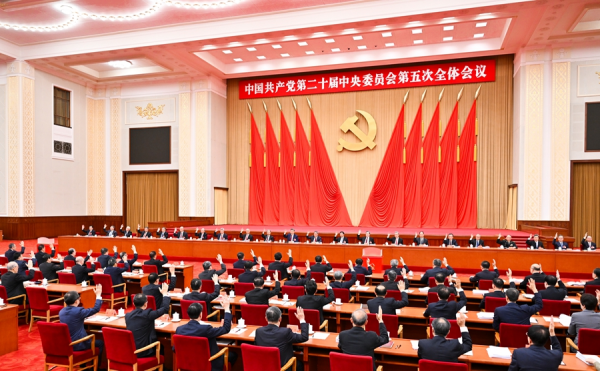
Xi Leads Plenum as CPC Adopts New Party Governance Resolution
The Communist Party of China (CPC) concluded a four-day plenary session with the adoption of a major resolution focused on strengthening Party self-governance, reinforcing anti-corruption efforts and tightening internal discipline as the country enters the early stage of its 15th Five-Year Plan period.
The Fifth Plenary Session of the 20th CPC Central Committee, held in Beijing from Oct. 26 to 29, was attended by 162 Central Committee members and 117 alternate members. General Secretary Xi Jinping presided over the meeting and presented a report on the work of the Political Bureau.
The plenum adopted a resolution on what it described as “persevering with full and rigorous Party self-governance,” reaffirming Party discipline, anti-corruption measures and political oversight as key priorities for the years ahead.
According to the communiqué, the Central Committee credited the Party leadership with progress in economic development, national security, military modernisation, governance, and social stability since the previous plenary session.
It said the 14th Five-Year Plan had been successfully completed and that the 15th Five-Year Plan period had begun with positive momentum.
The meeting highlighted Xi Jinping Thought on Party Building as a guiding framework for strengthening Party leadership and governance.
The communiqué said the Party must continue to improve its ability to govern, combat corruption and maintain political cohesion amid what it described as increasingly complex domestic and international challenges.
Delegates endorsed a comprehensive agenda for Party building, including stricter discipline enforcement, stronger oversight mechanisms, more rigorous management of officials, efforts to improve conduct within Party ranks and continued anti-corruption campaigns.
The communiqué reiterated support for an integrated approach to combating corruption through punishment, prevention and institutional reform, while stressing that supervision of power and accountability mechanisms should be strengthened.
The plenary session also announced that the CPC’s 21st National Congress will be convened in Beijing in the second half of 2027.
The congress is expected to take place during what the Party described as a critical stage in China’s drive toward the goal of basically realising socialist modernisation.
In personnel changes, Zhang Shengmin was elected a member of the Political Bureau. The Central Committee also approved the filling of several vacancies by alternate members.
The meeting confirmed earlier disciplinary decisions against a number of senior civilian and military officials accused of serious violations of Party discipline and law. Those measures included expulsions from the Party and other disciplinary sanctions.
The communiqué concluded with a call for Party members to unite around the Central Committee under Xi Jinping’s leadership, advance Party self-governance and support China’s broader modernisation goals.
Why this version works: It leads with the most consequential developments (the governance resolution, anti-corruption agenda, and 2027 Party Congress), removes ideological repetition, attributes claims to the Party rather than presenting them as fact, and follows a neutral wire-service structure focused on developments, decisions and implications.
