Nigeria-EU Set Roadmap For Strategic Cooperation At 8th Ministerial Dialogue
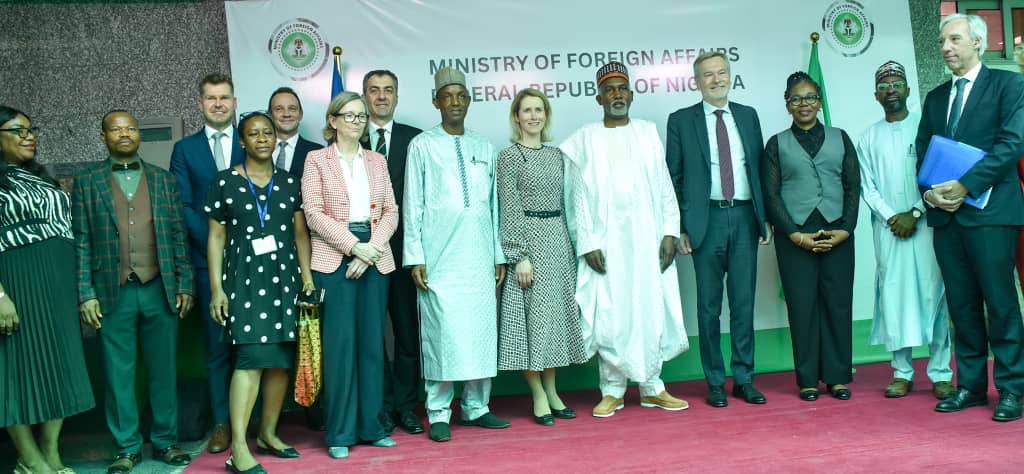
The Federal Republic of Nigeria and the European Union (EU) have concluded the Eighth Ministerial Dialogue, marking a significant step in reinforcing their strategic partnership amid “profound geopolitical uncertainty.”
The meeting, co-chaired by Nigeria’s Minister of Foreign Affairs, Yusuf Maitama Tuggar, and the EU High Representative for Foreign Affairs and Security Policy, Kaja Kallas, resulted in a comprehensive joint communique focusing on security, economic growth, and migration.
Diplomatic Milestones and Multilateralism
A key outcome of the dialogue was an official invitation for President Bola Ahmed Tinubu to visit Brussels, which the President has expressed a willingness to accept.
On the global stage, the EU formally signaled its support for a comprehensive reform of the UN Security Council. The proposal aims to make the council more inclusive and democratic by strengthening the voice of underrepresented regions, specifically Africa. Both parties reiterated their “unwavering support” for lasting peace in conflict zones, including Ukraine, Gaza, and the Sahel.
Security and Defense Integration
The dialogue highlighted a deepening military and intelligence relationship:
- European Peace Facility: The EU is exploring direct support to Nigeria under this facility to address internal security challenges.
- Regional Stability: Renewed support was pledged for the Multi-National Joint Task Force (MNJTF) in the Lake Chad Basin.
- Organized Crime: Both sides welcomed a new working arrangement between Nigerian law enforcement and Europol, targeting cybercrime, human trafficking, and “follow the money” tactics to disrupt criminal finances.
The “Global Gateway” and Economic Investment
The EU, currently Nigeria’s largest trading partner, announced several high-value investments under its Global Gateway strategy:
- Infrastructure: A €108 million joint initiative to roll out fiber optic cables across Nigeria.
- Agriculture & Health: EIB loans totaling €135 million to the Bank of Industry to boost healthcare manufacturing and dairy/cocoa value chains.
- Transportation: The Omi-Eko project, a €361 million electric waterway system for Lagos, was highlighted as a flagship “Team Europe” success.
Migration and Humanitarian Aid
For 2026, the EU has committed an initial €33 million in humanitarian aid, primarily for the North-East and North-West regions.
On the policy front, the two sides initialed the EU-Nigeria Readmission Agreement. This moves the partnership toward a “comprehensive and humane” migration framework that includes fighting migrant smuggling while simultaneously exploring Talent Partnerships to create legal pathways for Nigerian workers and students.
Innovation and Education
Nigeria continues to lead Africa in the number of students receiving Erasmus Mundus scholarships. To build on this, both delegations expressed a commitment to finalizing a formal Science, Technology, and Innovation (STI) Agreement by June 2026, focusing on AI, digital entrepreneurship, and smart farming.
The Ninth Ministerial Dialogue is slated to take place in Brussels in 2027.
